



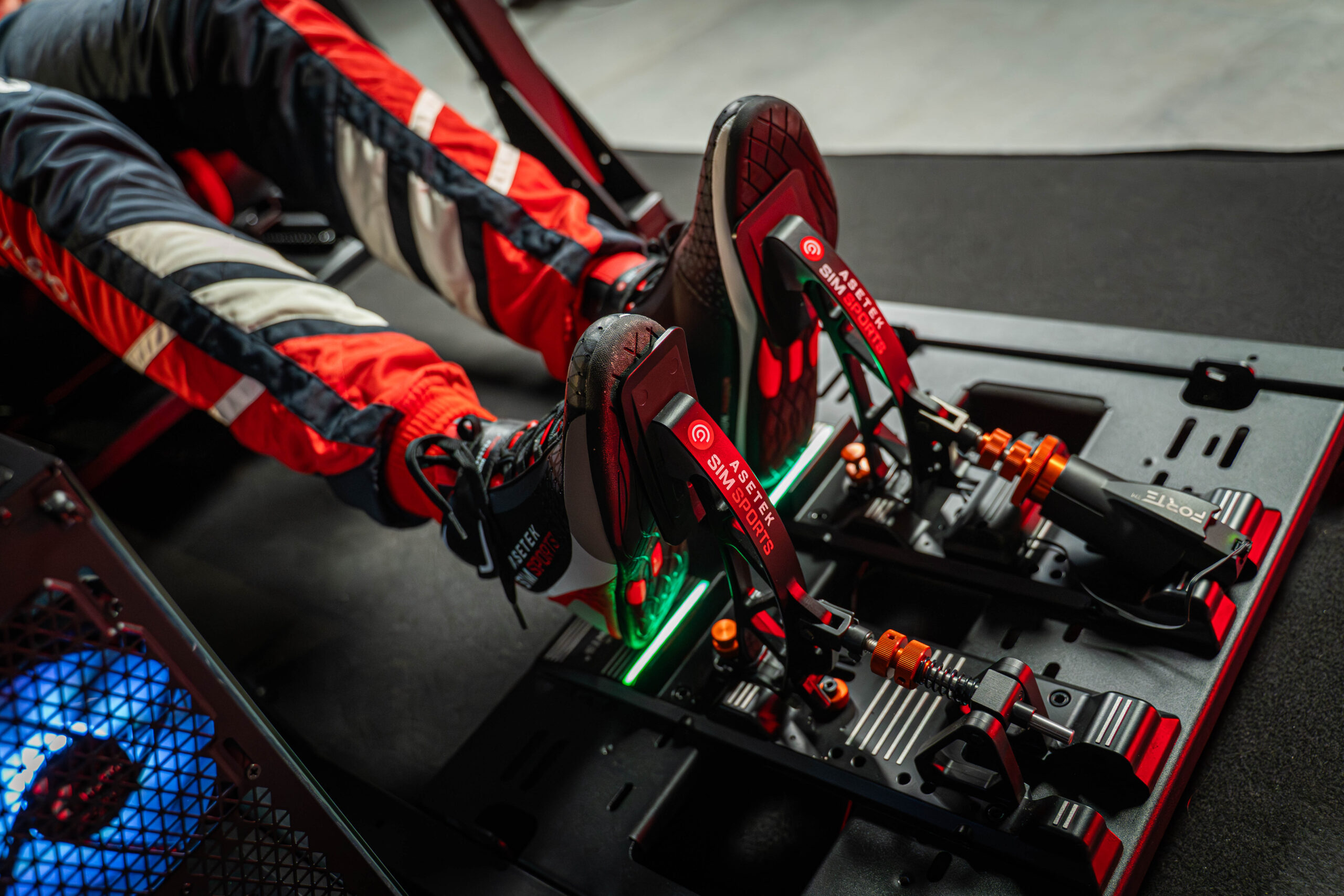
Sim Racing Pedal Position: Angle, Distance & Brake Control
Your sim racing pedal position has a direct impact on comfort, braking consistency, muscle memory, and control. If your pedals are too far away, too close, too flat, or too steep, you may struggle to brake consistently, keep your lower back supported, or apply smooth throttle input during long sessions.
A good pedal setup should let you press the brake firmly without stretching your leg, lifting your back from the seat, or creating tension in your hips, knees, or ankles.
In this guide, we’ll cover how to set your sim racing pedal distance, pedal angle, brake pedal position, throttle position, and overall pedal setup for better comfort, control, and consistency.
Why pedal position matters in sim racing
Pedal position is one of the most important parts of an ergonomic sim racing setup. Your pedals control braking, throttle input, trail braking, and car balance, so even small adjustments can change how consistent you feel behind the wheel.
A poor pedal position can lead to:
- Inconsistent braking pressure
- Overextended legs
- Lower back movement under braking
- Tension in your hips, knees, or ankles
- Less precise throttle control
- Fatigue during longer sessions
- Difficulty building muscle memory
A good pedal position helps you stay stable in the seat, brake with confidence, and repeat the same inputs lap after lap.
Sim racing pedal position checklist
Use this checklist to dial in a more comfortable and consistent pedal setup:
- Your knees should stay slightly bent at full brake pressure
- Your lower back should remain supported by the seat
- You should not need to stretch to reach the pedals
- Your ankles should move naturally without strain
- Your brake pedal should feel stable under heavy pressure
- Your throttle foot should rest comfortably
- Your pedal angle should match your seating position
- Your pedals should not move or flex under load
- Your feet should return naturally to the same position
- You should be able to drive for long sessions without discomfort
How far should your sim racing pedals be?
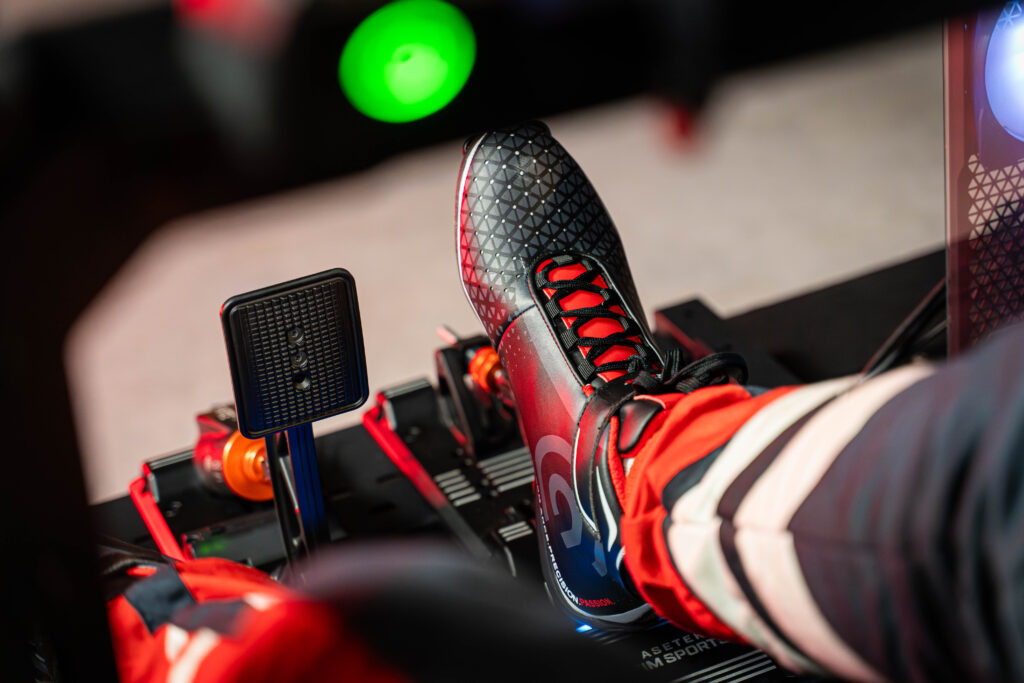
Your sim racing pedals should be close enough that you can fully press the brake without locking your knee or lifting your lower back from the seat. At maximum brake pressure, your knee should still have a slight bend.
If your pedals are too far away, you may start stretching your leg under braking. This can reduce control and make it harder to apply consistent brake pressure. If your pedals are too close, your knees may feel cramped, and your pedal inputs may become less smooth.
Your pedal distance is usually correct when:
- You can press the brake fully without stretching
- Your knee stays slightly bent
- Your back remains in contact with the seat
- Your hips stay stable under braking
- Your feet rest naturally on the pedals
- You can move between throttle, brake, and clutch without tension
A good way to test pedal distance is to press the brake as hard as you would in a race. If your body moves backward, your lower back lifts, or your leg fully locks out, your pedals are probably too far away.
What is the best pedal angle for sim racing?
The best pedal angle depends on your seating position.
A more upright GT-style seating position usually works well with pedals that are more vertical. A more reclined formula-style seating position may require a flatter pedal angle.
The goal is to keep your feet, ankles, knees, and hips in a natural position. You should be able to apply brake pressure without bending your ankle awkwardly or pushing from an unstable position.
A good pedal angle should:
- Match your seat angle
- Let your feet rest naturally
- Avoid excessive ankle strain
- Support smooth throttle control
- Help you brake without lifting your back
- Feel comfortable over longer sessions
If your ankles feel tense, your calves fatigue quickly, or your braking feels inconsistent, your pedal angle may need adjustment.
Brake pedal position and braking consistency
The brake pedal is the most important pedal to get right.
In sim racing, consistent braking is often more important than peak braking force. Your brake pedal position should allow you to apply pressure smoothly and repeatably without moving your body.
Your brake pedal should be positioned so you can push through the pedal with control while keeping your back, hips, and shoulders stable. If you need to reach for the brake, you will likely lose consistency.
For better braking control:
- Keep your brake foot naturally aligned with the pedal
- Avoid stretching your leg at full brake pressure
- Make sure your seat does not flex or move
- Keep your lower back supported
- Use a pedal position that allows repeatable pressure
- Adjust brake resistance to match your strength and preference
If you use load cell or hydraulic pedals, stability becomes even more important. Strong brake pressure can expose problems in your seating position, pedal distance, or cockpit stability.
Throttle and clutch positioning
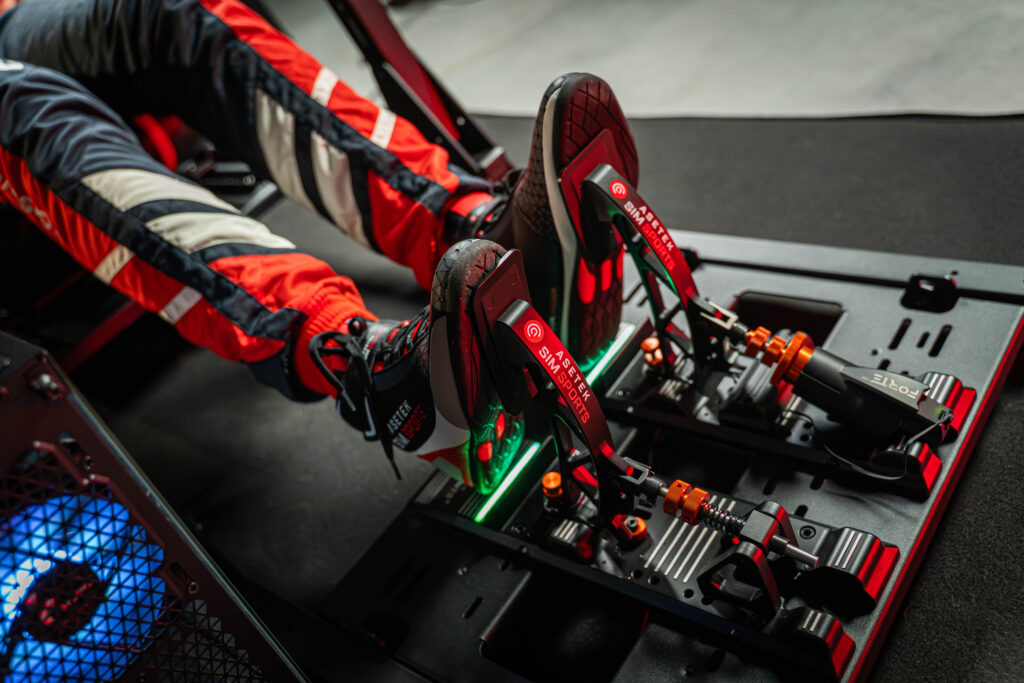
The throttle should feel smooth and easy to modulate. You should be able to apply small throttle inputs without lifting your leg, twisting your foot, or creating tension in your ankle.
For throttle control, focus on comfort and precision. Your foot should rest naturally, and you should be able to move through the pedal travel smoothly.
If you use a clutch pedal, make sure it is close enough to reach without shifting your body in the seat. If the clutch is too far to the side or too far away, it can disturb your posture and make starts or manual shifting less comfortable.
A good throttle and clutch setup should let you:
- Apply small inputs smoothly
- Keep your foot relaxed
- Avoid ankle strain
- Move between pedals naturally
- Keep your body stable in the seat
GT vs formula pedal position
Your ideal pedal position depends on the type of seating position you use.
GT-style pedal position
A GT-style seating position is more upright. Your pedals are usually placed lower and more vertical, with a seat angle closer to a regular car position.
This setup is good for:
- GT racing
- Touring cars
- Road cars
- General sim racing
- Beginners
In a GT-style position, make sure the pedals are not too far away. You should still be able to brake hard without locking your leg or lifting your back.
Formula-style pedal position
A formula-style seating position is more reclined. Your legs are usually more stretched forward, and the pedals may sit higher or at a flatter angle.
This setup is good for:
- Formula racing
- Single-seaters
- Low cockpit positions
- More immersive formula-style rigs
In a formula-style setup, pedal angle becomes especially important. If the angle is wrong, you may create tension in your ankles, hips, or lower back.
The best choice is not always the most realistic-looking setup. Choose the pedal position that gives you the best combination of comfort, control, and consistency.
Common sim racing pedal position mistakes
Placing the pedals too far away
If the pedals are too far away, you may stretch your leg when braking. This can reduce control and create tension in your hips or lower back.
Sitting too close to the pedals
If the pedals are too close, your knees may feel cramped, and your inputs can become less smooth. You may also find it harder to apply progressive brake pressure.
Using the wrong pedal angle
A pedal angle that does not match your seating position can create ankle strain and make braking feel unnatural.
Ignoring cockpit flex
If your pedal plate or cockpit moves under braking, your inputs become less consistent. A stable pedal platform is especially important with load cell or hydraulic pedals.
Adjusting too many things at once
Change one thing at a time. Adjust pedal distance, test it. Then adjust pedal angle, test it. Small changes make it easier to understand what actually improves your setup.
How pedals, seating position, and cockpit setup work together
Your pedal position cannot be adjusted in isolation. It should work together with your sim racing seating position, wheel position, monitor position, and cockpit setup.
Seat distance, back support, and leg angle all affect how consistently you can brake. If your seat is too far back, your pedals may feel too far away.
If your wheel is too far forward, you may compensate by changing your posture. If your cockpit flexes under braking, even the best pedal position will feel inconsistent.
For the best result, adjust your setup in this order:
- Set your seat position
- Adjust your pedal distance
- Adjust your pedal angle
- Set your wheel height and distance
- Check your monitor height, distance, and FOV
- Test everything over multiple laps
- Make small changes one at a time
A comfortable sim racing setup should feel stable, natural, and repeatable. The goal is not just to feel good for one lap, but to stay consistent across a full session.
Summary: how to set your sim racing pedal position
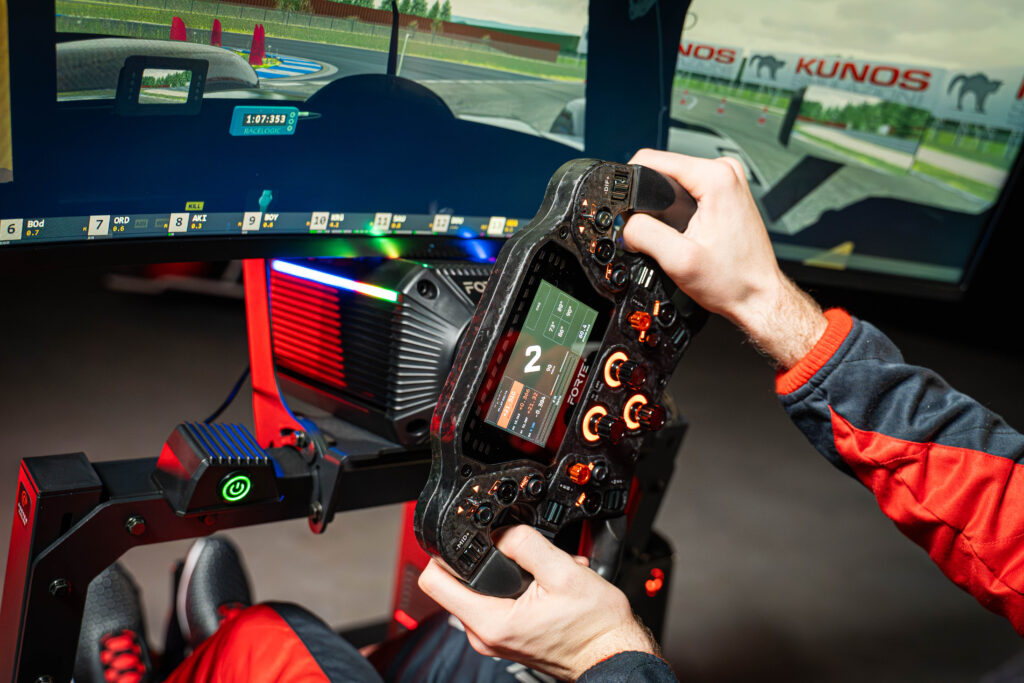
Your sim racing pedals should be positioned so you can brake firmly, control the throttle smoothly, and stay stable in the seat. The right position depends on your seat angle, driving style, pedal type, and cockpit setup.
As a rule of thumb:
- Keep a slight bend in your knees
- Avoid stretching for the brake
- Keep your lower back supported
- Match pedal angle to your seating position
- Make sure your pedals and cockpit do not flex
- Test changes over several laps
- Prioritize consistency over extreme realism
A well-positioned pedal set can make your whole sim racing setup feel more connected, comfortable, and predictable.
If you are building a full setup from scratch, a sim racing bundle can help you match your wheelbase, pedals, steering wheel, and cockpit from the start.
FAQ: Sim racing pedal position
How far away should sim racing pedals be?
Your pedals should be close enough that you can fully press the brake without locking your knee or lifting your lower back from the seat. At full brake pressure, your knee should still have a slight bend.
What is the best pedal angle for sim racing?
The best pedal angle depends on your seating position. Upright GT-style setups usually work well with more vertical pedals, while reclined formula-style setups may require a flatter pedal angle.
Should sim racing pedals be flat or angled?
They should be angled to match your seat position and natural foot movement. The goal is to avoid ankle strain while keeping good control over the brake, throttle, and clutch.
Why does my lower back lift when I brake?
Your pedals may be too far away, your seat may not support you properly, or your pedal resistance may be too high for your current setup. Move the pedals closer, check your seat angle, and make sure your cockpit is stable.
Does pedal position affect braking consistency?
Yes. If your pedals are too far away, too close, or unstable, it becomes harder to apply repeatable brake pressure. A correct pedal position helps improve muscle memory and braking consistency.
What is the best pedal position for GT racing?
For GT racing, a more upright seating position with comfortable pedal reach usually works best. Your knees should stay slightly bent, and you should be able to brake firmly without moving your back or hips.
What is the best pedal position for formula racing?
Formula-style seating is more reclined, so the pedals may need to be flatter or positioned higher. The most important thing is that your legs, ankles, and lower back remain supported and comfortable.




 Back to top